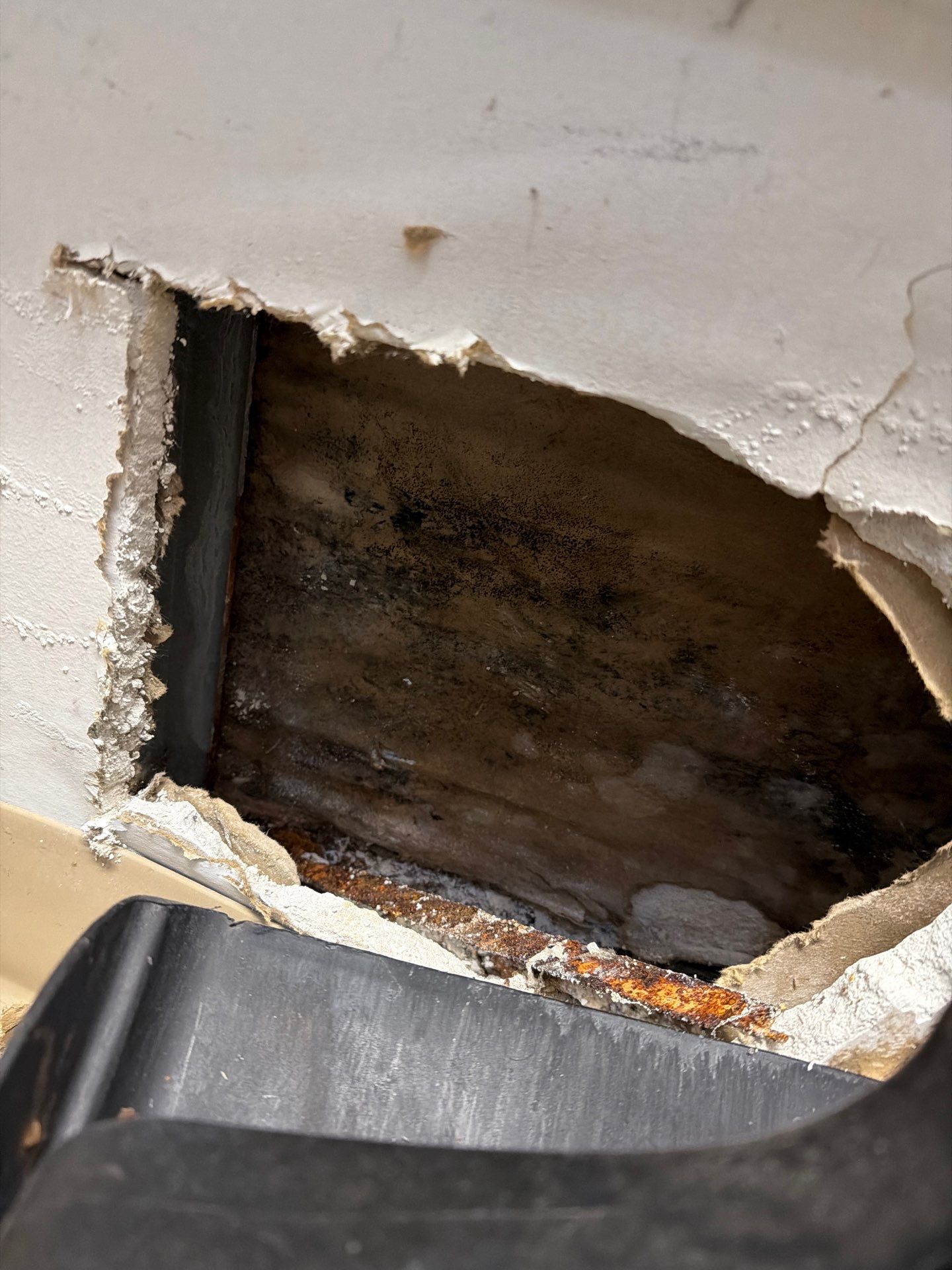
The 48 Hour Mold Growth Timeline: Exact Stages
- Hours 0 to 6: Water saturates porous materials. Drywall wicks moisture vertically at roughly 1 inch per hour. Carpet pad absorbs up to 8 times its dry weight. No visible mold yet, but spores already present in the air begin landing on wet surfaces.
- Hours 6 to 24: Spore hydration phase. Humidity in the affected room climbs above 70 percent. Cellulose materials (paper-faced drywall, wood framing, cardboard boxes) become viable food sources. Microbial volatile organic compounds (MVOCs) begin off-gassing, often producing a faint musty odor.
- Hours 24 to 48: Germination and hyphae formation. Mold colonies establish on drywall paper, subfloor decking, and insulation. Not yet visible to the naked eye but detectable with moisture meters showing readings above 16 percent and air sampling.
- Hours 48 to 72: Visible growth. Black, green, or white surface colonies appear. Spore counts in air samples typically exceed 1,500 spores per cubic meter, above normal indoor baseline.
- Day 4 and beyond: Active sporulation. Colonies release new spores into HVAC pathways and adjacent rooms. Remediation now requires containment, HEPA filtration, and material removal under IICRC S520 Condition 3 protocols.
Variables That Accelerate or Slow the Timeline
- Ambient temperature. Most common indoor molds (Aspergillus, Penicillium, Cladosporium, Stachybotrys) grow fastest between 70 and 90 degrees Fahrenheit. Below 60 degrees, germination can stretch from 48 hours to 96 hours or longer.
- Substrate type. Paper-faced drywall, untreated wood, and cellulose insulation support colonization within 24 to 36 hours. Painted concrete, glass, and metal rarely support growth unless coated in organic dust or biofilm.
- Water category. Category 2 and 3 water carry nutrient loads (proteins, sugars, organics) that accelerate germination by 6 to 12 hours compared to Category 1 supply line water.
- Air circulation. Stagnant air in closed rooms, behind furniture, and inside wall cavities allows moisture to pool and humidity to climb above 80 percent within hours.
- Pre-existing spore load. Properties with prior water events, untreated leaks, or HVAC contamination carry elevated baseline spore counts. Colonization on fresh wet surfaces happens 10 to 20 percent faster.
Moisture Thresholds That Trigger Remediation
- Drywall above 17 percent moisture content after 48 hours of active drying
- Subfloor (OSB or plywood) above 18 percent at 48 hours
- Framing lumber above 19 percent at 72 hours
- Relative humidity in the chamber above 60 percent despite running dehumidifiers
- Visible discoloration, surface staining, or musty odor on any porous material
- Air sample spore counts above 1,500 cells per cubic meter on indoor samples
- Tack strip or wood trim showing cupping, swelling, or delamination
- HVAC return air readings above 65 percent relative humidity post-extraction
Step by Step: What Stonewater Water Restoration Does Inside the 48 Hour Window
- Initial moisture mapping (Hour 0 to 1). We arrive with Protimeter and Tramex moisture meters, thermal imaging cameras, and a hygrometer. We document moisture content readings for every affected surface. Drywall baseline: under 1 percent. Wet drywall: 17 to 40 percent. Wood framing baseline: 7 to 12 percent. Wet framing: 20 to 30 percent.
- Category determination per IICRC S500. Category 1 (clean water from a supply line): drying typically viable. Category 2 (grey water from appliances or seepage): selective material removal. Category 3 (sewage or floodwater): mandatory removal of porous materials. Review our breakdown of Category 1 vs Category 2 vs Category 3 water damage for the full criteria.
- Water extraction (Hour 1 to 4). Truck-mounted extractors pull standing water at 150+ PSI. Weighted extraction tools compress carpet to remove pad moisture. Target: under 0.5 gallons remaining per 100 square feet before drying equipment is staged.
- Containment setup (Hour 4 to 6). For losses over 100 square feet or where mold risk is elevated, we install 6 mil poly barriers with zipper doors. Negative air machines with HEPA filtration run at 500 to 2,000 CFM depending on chamber size.
- Drying equipment deployment (Hour 6 to 8). Standard ratio: 1 air mover per 50 to 60 square feet of wet surface, 1 LGR dehumidifier per 1,000 to 1,500 square feet. Target chamber conditions: under 60 percent relative humidity, specific humidity under 55 grains per pound, temperature 70 to 90 degrees Fahrenheit.
- Antimicrobial application (Hour 8 to 12). EPA-registered botanical or quaternary antimicrobial applied to all wet surfaces. This buys time during the drying period and inhibits germination on borderline materials.
- Cavity inspection (Hour 12 to 24). Borescope inspection of wall cavities, under cabinet toe kicks, and beneath built-ins. Drilled weep holes in baseplates allow drying of sill plates without full demolition when readings permit.
- Daily moisture monitoring (Hour 24, 48, 72). Readings logged at the same mapped points. Drying goal: moisture content within 4 points of dry standard within 72 hours. If readings stall above 20 percent on drywall by hour 48, we cut and remove rather than continue drying.
- Material removal decision point (Hour 48). Porous materials still saturated at this mark trigger demolition: drywall removed 12 to 24 inches above the water line, wet insulation bagged and discarded, carpet pad cut and replaced.
Why the Clock Matters for Stonewater Properties
- Insurance carriers expect mitigation to begin within 24 to 48 hours. Delays beyond that frequently lead to coverage disputes citing failure to mitigate.
- Central Indiana humidity averages 70 to 80 percent in summer months, accelerating mold growth at the high end of the 24 to 48 hour window.
- Older Stonewater homes with plaster, lath, and balloon framing trap moisture in cavities where surface readings underestimate true saturation.
- Crawl spaces and basements with limited airflow reach germination thresholds faster than open living areas.
- Slab-on-grade construction common in newer Stonewater subdivisions wicks moisture laterally through concrete, extending the wet footprint 3 to 6 feet beyond the visible water line.
- Finished basements with vinyl plank flooring over pad trap moisture against the slab, hiding active growth for weeks without surface indicators.
Homeowner Actions Within the First 24 Hours
- Shut off the water source at the supply valve or main if the leak is active.
- Document every affected room with photos and video before moving items. Insurance adjusters request pre-mitigation documentation.
- Move undamaged contents out of the wet zone. Wood furniture left on wet carpet can transfer stain and absorb moisture within 6 hours.
- Do not run the HVAC system if water has entered ductwork or return cavities. Recirculation spreads spores building-wide.
- Open windows only if outdoor dew point is below indoor temperature. Otherwise outside air adds moisture rather than removing it.
- Call a certified mitigation contractor before hour 12 to preserve the full 48 hour drying window.
If mold has already established beyond the 48 hour window, the job transitions from drying to remediation under IICRC S520. Our mold after water damage removal guide walks through containment, HEPA air scrubbing, and clearance testing. For the underlying water event itself, the professional drying timeline covers expected equipment runtime and the science behind psychrometric drying.